
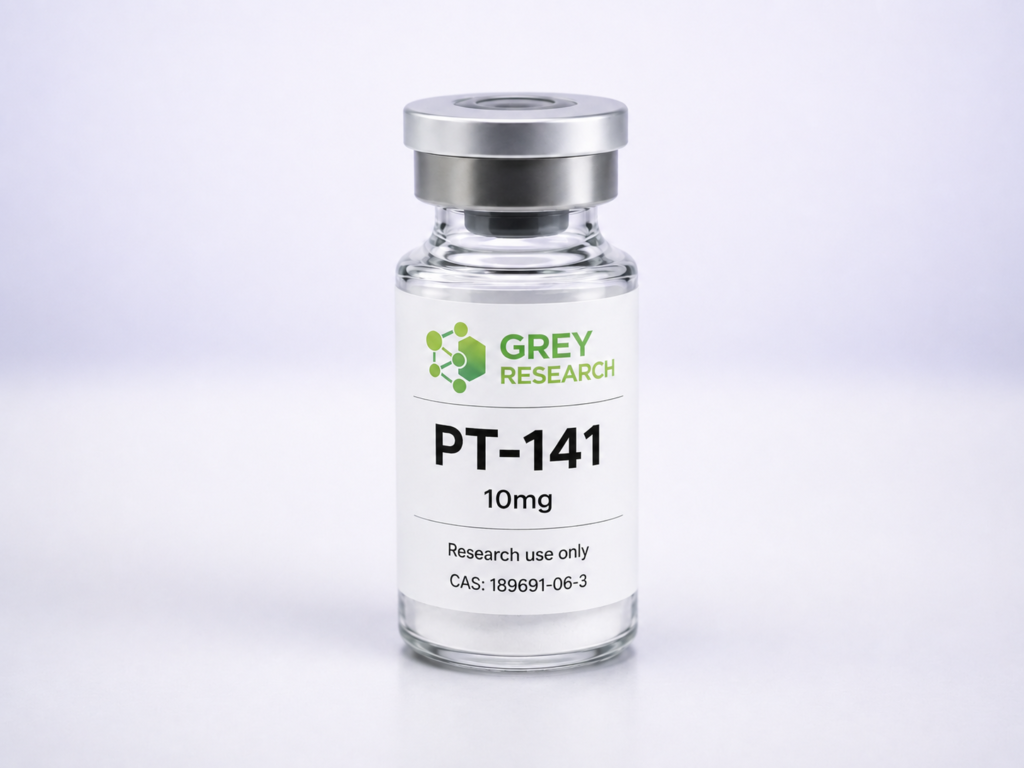
Melanocortin Receptor Agonist | CAS: 189691-06-3
Overview
PT-141 (bremelanotide) is a cyclic heptapeptide melanocortin receptor agonist originally derived from Melanotan II. While MT-2 is a non-selective melanocortin agonist, PT-141 was specifically optimized for MC3R and MC4R activity in the central nervous system. It is the only known compound that addresses arousal through a direct neurological mechanism rather than vascular pathways.
PT-141 differs from PDE5 inhibitors (which act peripherally on vascular smooth muscle) by working centrally through hypothalamic melanocortin and dopaminergic pathways. This unique mechanism has made it a critical research tool for understanding CNS-mediated sexual function.
Mechanism of Action
- MC4R activation: Primary target. MC4R receptors in the paraventricular nucleus (PVN) and medial preoptic area (MPOA) of the hypothalamus mediate sexual arousal signaling. Activation triggers downstream oxytocin release and dopaminergic signaling.
- MC3R activation: Secondary target. MC3R in the hypothalamus modulates energy partitioning and may contribute to motivational aspects of arousal.
- Dopaminergic pathway: MC4R activation in the hypothalamus leads to increased dopamine release in the MPOA, a critical area for sexual motivation and arousal. This dopamine release is thought to mediate the central arousal effects.
- Oxytocin release: MC4R activation in the PVN triggers oxytocin release, which acts on spinal cord neurons controlling erectile and genital arousal reflexes.
- Distinct from PDE5i: Does not require nitric oxide or cGMP pathways. Acts upstream of vascular effects through CNS signaling. Effective regardless of endothelial function.
Pharmacokinetics
- Half-life: Approximately 2.7 hours following subcutaneous administration.
- Onset: Effects observed within 30-60 minutes.
- Duration: Effects may last up to 6-12 hours in research models.
- Bioavailability: High subcutaneous bioavailability due to cyclic structure.
- Metabolism: Hepatic peptidase degradation.
Published Research
- Diamond et al. (2006) — Journal of Sexual Medicine: Demonstrated dose-dependent increases in sexual desire and arousal in premenopausal women with FSAD. Significant improvement in satisfying sexual events.
- Safarinejad (2008) — Journal of Sexual Medicine: Dose-response study in men with erectile dysfunction. PT-141 produced erections in 9/10 subjects at optimal dose, including in patients who had failed PDE5 inhibitors.
- Clayton et al. (2016) — Obstetrics & Gynecology: RECONNECT phase 3 trials (n=1,247). Statistically significant improvements in desire, arousal, and distress scores in premenopausal women with HSDD.
- Kingsberg et al. (2019) — Obstetrics & Gynecology: Long-term safety data from RECONNECT extension study. Maintained efficacy over 12 months with consistent safety profile.
- Molinoff et al. (2003) — Annals of the NY Academy of Sciences: Early characterization of PT-141 mechanism. Established the CNS pathway as distinct from peripheral vascular mechanisms.
- Rosen et al. (2004) — Journal of Urology: RigiScan data confirming centrally-mediated erectile response in male subjects, supporting MC4R pathway hypothesis.
Research Applications
- Melanocortin receptor signaling in CNS
- Sexual function and arousal pathway research
- Hypothalamic dopamine-oxytocin interaction studies
- MC4R structure-activity relationships
- Comparison studies with PDE5 inhibitor pathways
- Mood and motivational behavior research
Chemical Properties
- Sequence: Ac-Nle-c[Asp-His-D-Phe-Arg-Trp-Lys]-OH (metabolite of MT-2 lacking C-terminal amide)
- Molecular Weight: 1,025.18 g/mol
- CAS Number: 189691-06-3
- Appearance: White lyophilized powder
- Storage: -20°C lyophilized; 2-8°C reconstituted
Disclaimer: This information is compiled from published peer-reviewed research for educational purposes only. Grey Research compounds are intended for in vitro research and laboratory use only. Not for human consumption.